


Overview

New to lacrosse? Let us help you get started.

You don't have to know anything about the game yet. Plenty of parents land here the same way you did. A kid came home excited, and suddenly there's a stick in the house and a season starting in three weeks. Nobody expects you to know a crease from a clear.

This page is a guide to boys' lacrosse for families new to the sport: how the game is played, what your son will wear, the words you'll hear from the sideline, the ways he can play, and how the sport grows with him.

So before you go any further, your next question might be, "What is USA Lacrosse?" USA Lacrosse is the national governing body for the sport in the United States. In practice, that means we're the ones responsible for it, from the standards to the coach education to the safety guidelines.

Everything on this page is yours, free. When he's ready to take the field, a USA Lacrosse membership adds what a first season asks for: coverage that travels with him while he plays, instruction built for beginners thru highest levels of competition, and a directory of trusted programs near you.

Jump to any section below. 

Equipment Overview

OVERVIEW
Helmet
Sticks
Shoulder Pads
Arm pads
Gloves
Protective Cup
Mouthguard

New lacrosse parents are often surprised that boys' players wear so much more protective equipment than girls' players. The reason is the rules, not a difference in how physical the game feels to play. Boys' lacrosse allows body checking and stick checks above the shoulders, which is why boys wear a helmet, shoulder pads, and arm pads in addition to a stick and mouthguard.

Introductory formats like Flex6 are designed for first-time players and don't require protective equipment.

Terminology

Tap to learn more3 / 9

CREASE

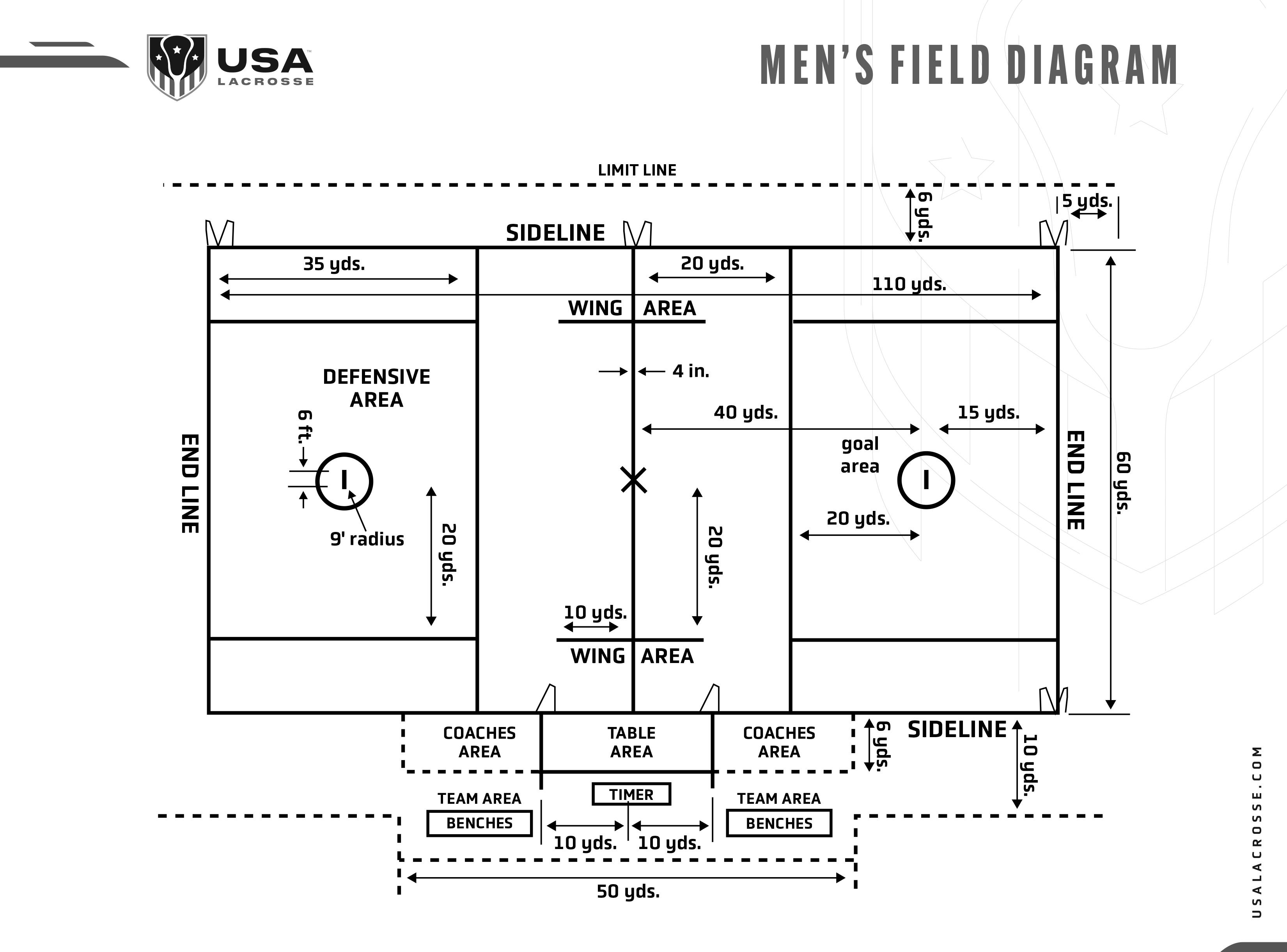
The circle around the goal, with a 9-foot radius, that only defensive players and the goalkeeper are allowed to enter.

GOAL-LINE EXTENDED

An imaginary line that runs from the goal line out to the sidelines — you'll hear it used to describe where a shot or pass started from relative to the goal.

BODY CHECK

Overt, obvious body contact made to an opponent. Legal within the rules of the boys' game — this is the core difference from girls' lacrosse, which prohibits body contact.

Game Formats

There are three main disciplines in lacrosse — traditional field lacrosse, sixes and box. Field lacrosse is the predominant version of the sport in the United States. Sixes will be used for the LA28 Olympics and the USA Lacrosse Flex6 version offers adaptability for youth leagues. Box lacrosse is Canada's national summer sport and growing in popularity in the United States.

Together, these disciplines create more opportunities for participation, player development, and fan engagement. While each format emphasizes different skills and experiences, all three share the same fundamental objective: combining athleticism, teamwork, creativity, and competition through the game of lacrosse.

Traditional men’s field lacrosse is a fast-paced, full-contact team sport played by 10 players per side on a field roughly the size of a football field (110 x 60 yards). Each team consists of three attackmen, three midfielders, three defensemen, and one goalkeeper. Only six players are allowed into the offensive zone and up to four players on defense are allowed to use longer poles to help with checking and ball pressure.

The game combines speed, skill, strategy, and physical play, requiring players to use a lacrosse stick (crosse) to catch, carry, pass, and shoot a rubber ball with the objective of scoring in the opponent’s goal.

Field Diagram

Athlete Development

We’re transforming how young athletes experience lacrosse. Grounded in research and best practices, our approach ensures every player — at every age and stage — can grow, thrive, and love the game.

Featured

Meet Matt Campbell, One of the Best Midfielders at the Perfect Time

As one of the most dynamic midfielders in the world, he’s chasing a place on the sport’s biggest stage.

Read More